
One model for building a sales organisation that holds. An honest assessment at the centre. Six areas that have to work together. Three ways we deliver. AI built in, not bolted on.
Most sales transformation is really just a technology project. Buy a CRM, standardise the process, roll out a method, call it done. The results speak for themselves: only 11% of sales organisations come out stronger, around 30% improve and hold the gain, and 88% fall short of what they set out to do.
The reason is always the same. They fix the wrong thing. Real change means fixing how you sell, how you are led, how your people are supported, and how the business runs, together, and without dropping this quarter’s numbers.
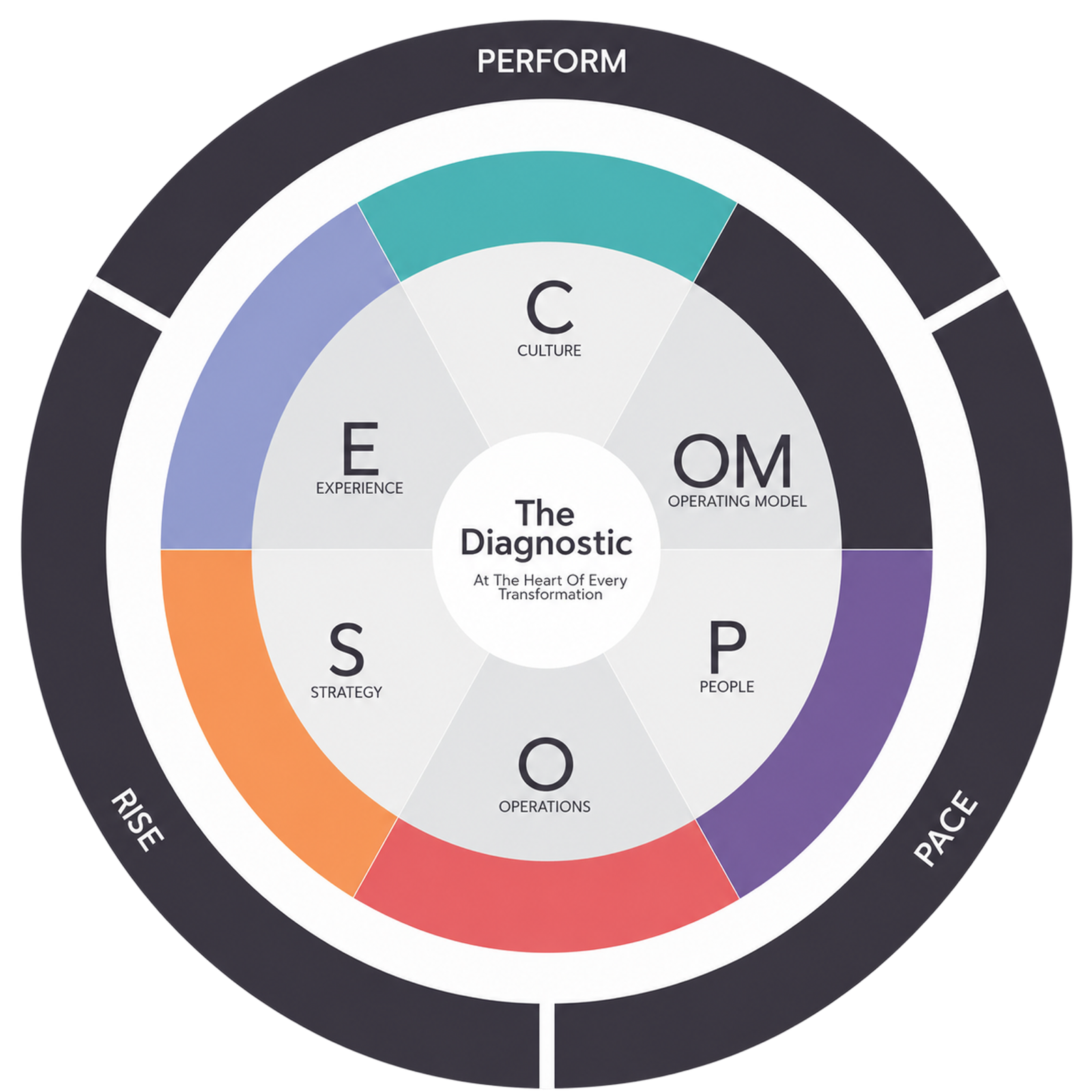
The COMPOSE Sales Model® is our answer. Six areas that work as one system. Pull one out, and the whole thing wobbles.
Low adoption, isolated impact
Systemic, sustainable performance
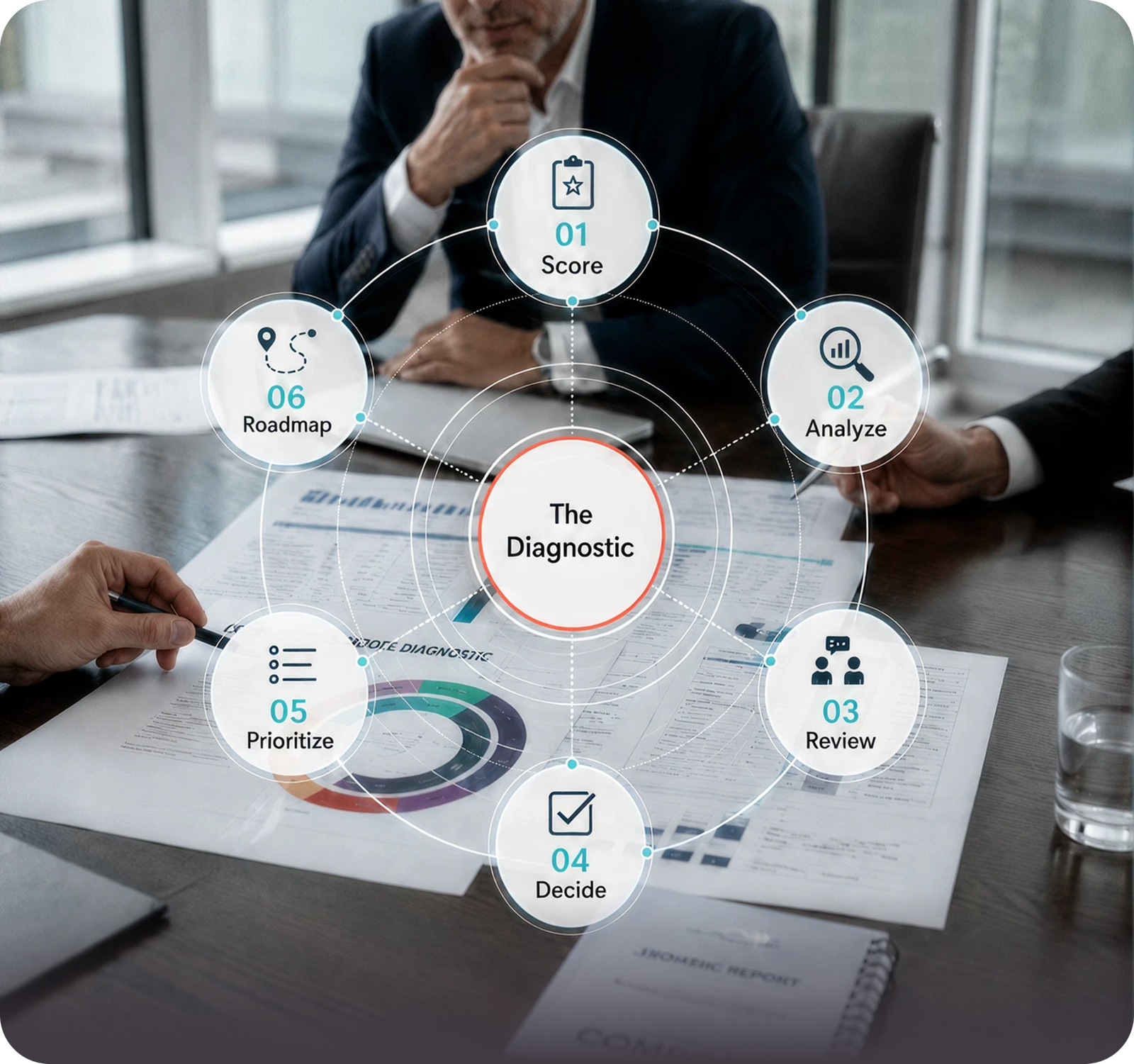
Where you stand, looked at honestly.
The six things every strong sales organisation gets right.
How we deliver the change.
Everything starts with the Diagnostic™. It looks at your sales organisation across all six areas and shows you what to fix first. Built and proven over two decades, across telecoms, technology, software, media, and manufacturing. It is your starting point: clear, honest, and ready for the board.
The six things every strong sales organisation gets right.
The mood and mindset of your sales floor. Get this wrong and nothing else holds.
How you are set up to sell: regions, segments, roles, and rhythm. It decides who can win before anyone picks up the phone.
Getting your reps and managers ready to win, and keeping the pipeline full. Where strategy becomes what people actually do.
The engine room: process, tools, data, and pay. It turns strategy into repeatable selling and gives you numbers you can trust.
Where you play and how you win. Market, segments, coverage, and the plan to turn it into revenue.
Getting it right for the customer, the partner, and the seller at the same time. Most programmes fix one and break the other two.
Each one focuses on a different part of the sales organisation.
Anchored against Strategy + Operating Model
The plan for where you play, how you cover the market, and how you are set up to sell.
Anchored against People
Getting sellers ready to win, and keeping new work coming in.
Anchored against Operations
Clean process, connected tools, and a weekly rhythm you can trust.
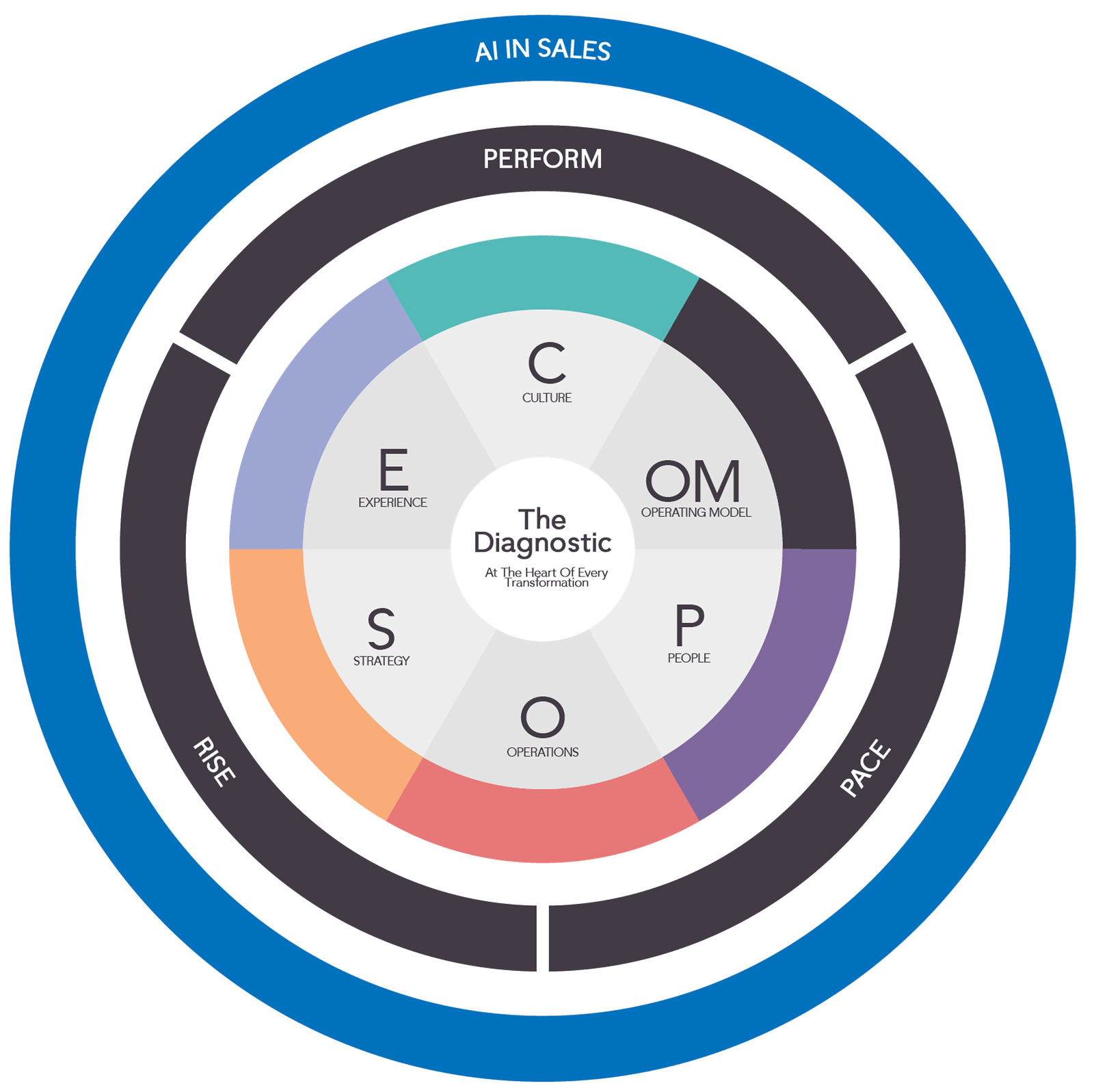
AI is not a seventh area. It runs through the whole model. Smarter targeting in strategy, better coverage in the operating model, faster ramp and coaching for people, sharper forecasting and less admin in operations. But AI only works on clean data, and that foundation lives in RISE. Get the data right first, or you just scale the mess.
Underpinning all of it is the data model and architecture inside RISE. Bain’s research is consistent on this: AI value capture depends on data foundations. Without them, AI accelerates inefficiency rather than removing it.
AI has made analysis fast and close to free. What it has not made easier is sequencing: which constraint to remove first, what that unlocks, and how much change an organisation can absorb in a quarter. By combining sales domain expertise, AI applied to the client’s own situation, and practitioners who have owned the outcome, we get to the order of work quickly and then deliver against it.

Managing Partner
Four steps, led personally from inside your team.
Understand
We find out where you stand across all six areas, and what to fix first.
Design
We build the fix, shaped to your business, not a template.
Do the work
We lead it with your team, hands-on. We build it and run the function through the change. No throwing decks over the fence.
Hand over
We hand it over clean and step out. Your team owns it from here.
Worth a conversation first. How we approach this, where we would start, and whether it fits what you need. Nothing more than that.

A practitioner-led sales transformation practice anchored on the COMPOSE Sales Model®.
Copyright © Compose Sales Partners Limited. COMPOSE Sales Partners, the Compose Sales Partners logos, COMPOSE Sales Model is a trademark and service mark of COMPOSE Sales Partners Limited. PERFORM, PACE, and RISE are proprietary frameworks of COMPOSE Sales Partners. Other brands and product names are the trademarks of their respective companies.

The challenge
An award-winning commercial enablement function had to be designed and built from the ground up, covering plays, academy, content, engagement, and the platform that runs them. The bar was set high. It had to be measurable, evidenced, and connected to revenue outcomes, not a content library.
What was done
· Designed and led the full commercial enablement function as the accountable VP. Owned the operating model and all four Centres of Excellence (Plays and Pipeline Creation, Academy, Content, Engagement).
· Built the three-tier sales play system from Anchor Value Story through Core Value Propositions to Tactical Plays, with bill of materials and activation.
· Built the Pipeline Creation engine. Cadenced prospecting, marketing-sales-product-inside-sales interlock, pipeline coverage as the managed outcome.
· Built the Academy across Foundations (Ready to Sell), Skills by role, and the Leadership Academy with a proprietary hiring framework.
· Architected the content discipline (hero/L1/L2/L3 tiering, governance, decay management).
· Selected and led implementation of the enablement platform. Designed the engagement model (manager rhythms, deal coaching, flagship events) with a single voice across all of it.
Outcome
Internal Innovation Award for the function and approach. Pipeline coverage uplift of 1.7x to 3.2x off a €6.5 million sales kick-off event spanning 1,650 people. Material improvement in onboarding-to-productivity time. Play adoption and content engagement evidenced at function level. A manager layer enabled to coach deals rather than chase forecasts.

The challenge
The corporate sales function needed a new strategy and a partner programme designed to extend reach into segments the direct organisation could not cover economically. The existing partner motion was disconnected from the direct go-to-market, with overlapping accounts, unclear economics, and inconsistent value propositions.
What was done
· Designed the corporate sales strategy. Segmentation, coverage, channel mix.
· Designed and operationalised the partner programme. Tiering, enablement, deal registration, partner business plans, economics.
· Aligned partner and direct motions to remove conflict and create complementary coverage.
· Led the rhythm of business and reporting that gave leadership confidence in partner-sourced and partner-influenced revenue.
Outcome
Coherent partner programme operating in market with clear economics. Partner-sourced and partner-influenced revenue evidenced through structured reporting. Direct and indirect motions complementary rather than competing.

The challenge
Following a major acquisition, two commercial organisations had to be integrated into one without losing the run-rate. Operating models, processes, tools, plays, and ways of working were duplicative, inconsistent, and slowing the combined organisation down. Sellers were navigating two systems and two cultures.
What was done
· Designed the unified commercial operating model post-merger. Segmentation, coverage, organisation design, role architecture, decision rights, governance.
· Designed the unified enablement function using the PACE framework. Single plays system, single Academy, single content discipline, single engagement model.
· Led the lead-to-cash process rationalisation and the supporting architecture decisions.
· Built the rhythm of business and forecast discipline that gave the combined organisation a single source of truth.
· Mobilised the cultural integration alongside the structural one. Recognition, communications, manager activation.
Outcome
Combined commercial organisation operating as one inside the integration window. Orders growth of +2.4 percent representing $6.7 million across more than 2,000 sellers. Sellers operating on a single set of plays, content, and processes across the combined business. Internal Transformation Award.

The challenge
Following a major acquisition, two commercial organisations had to be integrated into one without losing the run-rate. Operating models, processes, tools, plays, and ways of working were duplicative, inconsistent, and slowing the combined organisation down. Sellers were navigating two systems and two cultures.
What was done
· Designed the unified commercial operating model post-merger. Segmentation, coverage, organisation design, role architecture, decision rights, governance.
· Designed the unified enablement function using the PACE framework. Single plays system, single Academy, single content discipline, single engagement model.
· Led the lead-to-cash process rationalisation and the supporting architecture decisions.
· Built the rhythm of business and forecast discipline that gave the combined organisation a single source of truth.
· Mobilised the cultural integration alongside the structural one. Recognition, communications, manager activation.
Outcome
Combined commercial organisation operating as one inside the integration window. Orders growth of +2.4 percent representing $6.7 million across more than 2,000 sellers. Sellers operating on a single set of plays, content, and processes across the combined business. Internal Transformation Award.

The challenge
A multinational B2B business needed to reset enterprise GTM following years of inorganic growth. Coverage was inconsistent across regions, segmentation lacked discipline, the operating model was federated by accident rather than design, and the data architecture beneath the commercial engine had visibility gaps that made forecast and planning untrustworthy.
What was done
· Ran a structured organisational capability assessment across the commercial organisation. The forerunner of the COMPOSE Sales Model Diagnostic™.
· Designed the enterprise GTM strategy and the operating model that supported it. Segmentation, coverage, account tiering, rhythm of business.
· Architected the data and reporting backbone for executive visibility and forecast discipline.
· Led the cross-functional alignment between sales, marketing, product, and finance behind a single plan.
· Mobilised the change across regions, respecting local market nuance while holding a consistent global standard.
Outcome
Revenue scope of £800 million to £1.2 billion across post-merger commercial integration. Material improvement in coverage quality, segmentation discipline, forecast accuracy, and pipeline coverage. Operating model and rhythm of business embedded across all three regions.