Focused, scoped engagements against one commercial system layer. designed from the diagnostic and delivered through Perform, Pace, or Rise where the evidence shows the work needs to happen.


A Pillar Engagement is a discrete, scoped transformation engagement against one of the three COMPOSE frameworks. The frameworks are not generic capability areas. They are the proprietary, codified ways we deliver. Each one anchors a different layer of the commercial system, and each one is a real, commissionable service in its own right. Three Pillar Engagements are offered. You can commission one, or sequence two over time. They share a common shape:
What we work on is calibrated to what the assessment surfaced, not a templated rollout.
Focused enough to land, long enough to embed.
We lead the work. Your team owns the outcome.
No hand-off to junior consultants.
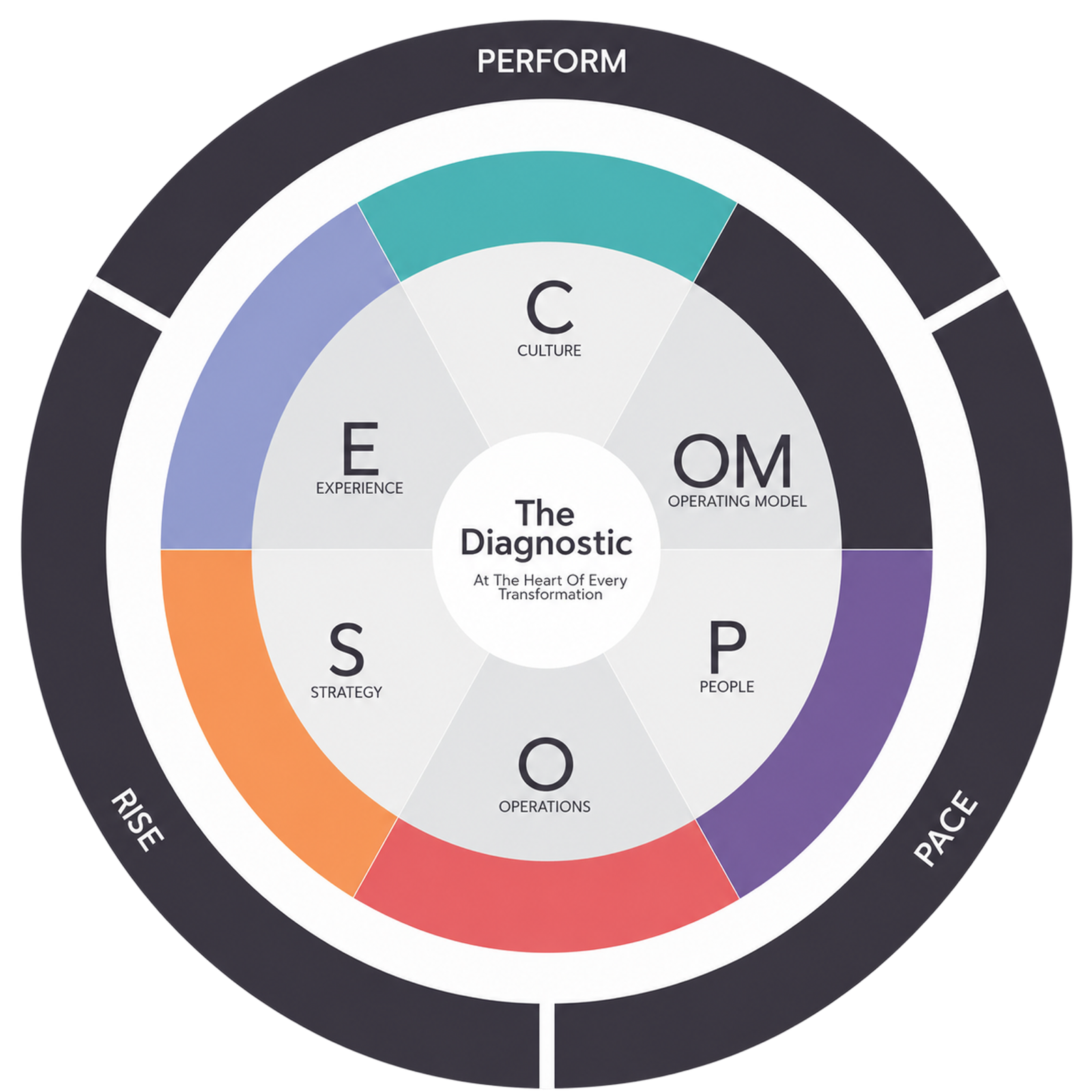
Entry point. Assesses the whole system. Scores the commercial organisation across all six pillars and surfaces what to address first.
What COMPOSE is. The six interconnected components of a high performing sales organisation. Each coloured segment represents one pillar.
How we deliver. PERFORM, PACE, and RISE. Each anchored against a different layer of the commercial system, shown in the outer ring.
Sales strategy and go-to-market
Anchored against the perfrom framework. Strategy + operating model pillars.
Growth has stalled or the path to the next stage is not clear. Coverage does not match the opportunity. Segments are served the same way regardless of value. The operating model is federated by accident, not by design. The growth plan is not anchored to a credible financial model. A new strategy needs to be designed, or an existing one needs to be made executable.



Addressable market, demand signal, segment-level opportunity sizing, propensity modelling.


How we engage and through what motions.


Direct, partner, digital, hybrid. Channel mix and economics.


Where we play and where we deliberately do not.


Structural set-up for execution. Regions, segments, organisation design, role architecture.

Cadences, MBR/QBR, forecast calls, governance forums.


Leading and lagging KPIs, dashboards, compensation and incentives.
Commissioned individually or in combination, depending on what the diagnostic surfaces.
GTM strategy
advisory
Designing the go-to-market from the market back. Addressable market sizing and demand modelling, ICP definition, segmentation, value proposition design, propositioning, propensity and opportunity modelling, channel mix and economics, competitive frame, financial planning model that connects strategy to credible targets. The output is a defensible GTM strategy a board can sign behind, a CFO can finance against, and a sales organisation can execute.
Operating model and organisation design
Designing the go-to-market from the market back. Addressable market sizing and demand modelling, ICP definition, segmentation, value proposition design, propositioning, propensity and opportunity modelling, channel mix and economics, competitive frame, financial planning model that connects strategy to credible targets. The output is a defensible GTM strategy a board can sign behind, a CFO can finance against, and a sales organisation can execute.
Commercial planning and performance design
Designing the go-to-market from the market back. Addressable market sizing and demand modelling, ICP definition, segmentation, value proposition design, propositioning, propensity and opportunity modelling, channel mix and economics, competitive frame, financial planning model that connects strategy to credible targets. The output is a defensible GTM strategy a board can sign behind, a CFO can finance against, and a sales organisation can execute.
Enablement and pipeline creation
Anchored against the Pace framework. People pillar.
Enablement is treated as training. Onboarding is slow, certifications do not change behaviour, content sits unused, and managers were not enabled to enable. Pipeline coverage is not where it needs to be, or when it is, it is the wrong mix. There is no clear line from enablement spend to revenue outcome. The function needs to be designed, built, and embedded, or the function exists and is not working.

The four layered components of pace.


The three-tier sales play system (Anchor Value Story, Core Value Propositions, Tactical Plays) with bill of materials and activation. And the pipeline creation engine: cadenced prospecting, the marketing-product-sales-inside-sales interlock, campaign and demand orchestration. Pipeline coverage as the managed outcome.


Foundations (Ready to sell), skills by role and seniority, and a leadership academy with a proprietary hiring framework that builds the manager layer.


Hero / L1 / L2 / L3 content tiering with governance, taxonomy, decay management, and performance analytics tied back to deal outcomes. Built with a seller mindset, not a marketing one.


Enablement platform. Manager rhythms, deal coaching, embedding cadence. Flagship events (SKOs, leader summits, customer events) as marquee moments. A single voice across all of it.
Commissioned individually or in combination, depending on what the diagnostic surfaces.
Plays and Pipeline
Creation
Designing and building the play system and the pipeline engine that fuels it. The three-tier sales play system. Anchor Value Story. Core Value Propositions. Tactical Plays. Bill of materials, activation cadence, and performance analytics. The Pipeline Creation engine. Cadenced prospecting. Marketing, product, sales, and inside-sales interlock. Campaign and demand orchestration. Pipeline coverage as the managed outcome. The output is a connected discipline that turns strategy into seller behaviour and demand into qualified pipeline.
Academy Design, Build, and Launch
Designing, building, and launching the learning architecture for the commercial organisation. Foundations (Ready to Sell). Skills curricula by role and seniority. Leadership Academy with a proprietary hiring framework that builds the manager layer. Certification and competency model. Onboarding-to-productivity discipline. Coach-the-coach cadence. The output is a manager layer enabled to coach deals and a seller layer that compounds capability over time.
Events, Engagement and Content Services
The seller-facing platform that activates and sustains the function. Flagship events as marquee moments. Sales kick-off (SKO), leader summits, customer events, regional engagements. Enablement platform selection and operating model. Manager rhythms, deal coaching, and embedding cadence. Full content service. Hero, L1, L2, and L3 content tiering. Governance, taxonomy, decay management, and performance analytics tied back to deal outcomes. Built with a seller mindset, not a marketing one. The output is a single voice and a sustained operating rhythm across the commercial organisation.
Anchored against the Rise framework. Operations pillar.
Sellers spend too much time on admin and not enough selling. Data cannot be trusted. Forecasting is an art, not a science. CPQ is slow, approvals leak, the tech stack has sprawled. Compensation drives the wrong behaviour. The rhythm of business is a series of disconnected meetings rather than a connected operating cadence.

The three connected components of Rise.


Lead management, opportunity management, quote management (CPQ, pricing, discounting, approvals), contract negotiation, order completion, forecast methodology. Plus account mastering, product mastering, territory management, white space analysis, commissions design, and data discipline. Explicitly scoped out: order management, fulfilment, revenue recognition, cash collection. These are finance and supply territory.


The full sales stack designed and architected: CRM, CPQ, enablement platform, conversation intelligence, revenue intelligence, sales engagement, ICM/SPM, guided selling, AI platform, marketing automation, analytics/BI. We design and architect. We partner with implementation specialists for build.


Weekly forecast cadence and forecast call discipline. MBRs and QBRs. Account planning and reviews. Partner business plan reviews. Pipeline and demand-gen reviews. Sales 1:1s, sales management coaching, performance management. All underpinned by a single source of truth.
Commissioned individually or in combination, depending on what the diagnostic surfaces.
Process Design and Rhythm of Business
Designing the sales-side lead-to-cash process and the cadence that runs it. Lead management, opportunity management, quote management (CPQ, pricing, discounting, approvals), contract negotiation, order completion, and forecast methodology. The weekly, monthly, and quarterly rhythm of business that holds the organisation to it. Forecast cadence and call discipline (commit, best case, pipeline coverage, conviction-based, AI-augmented). MBRs, QBRs, account planning reviews, partner business plan reviews, pipeline and demand-gen reviews, sales one-to-ones, and management coaching. The output is a defensible, measurable, repeatable process and the cadence that compounds it into performance.
System, Data, and AI Architecture
Designing and architecting the front office stack as a connected system. CRM as the spine, with configure-price-quote, contract lifecycle and digital signature, enablement platform, conversation and revenue intelligence, sales engagement and cadenced outreach, incentive compensation management, partner relationship management, marketing automation, lead management, and the analytics and BI layer designed together. AI woven across the stack rather than bolted on. Agents positioned alongside, doing the work the architecture frees them to do. Data mastering, governance, and the single source of truth that leadership can run the business from. We design and architect. We partner with implementation specialists for build.
Sales Operations Function Design
Designing the Sales Operations function itself. Organisation design, role architecture, and capability model for the function. Operating model and governance with the commercial organisation. Business partner model, escalation paths, and decision rights. Hiring framework and capability roadmap. Performance metrics for the function itself. The output is a Sales Operations function structured to professionalise the commercial engine, not a back-office team chasing data requests.
Pillar engagements usually follow the Diagnostic and can lead into wider programme work or interim leadership where the work needs to be landed inside the business.
Start with the diagnostic, then commission the framework engagement that the evidence calls for.

A practitioner-led sales transformation practice anchored on the COMPOSE Sales Model®.
Copyright © Compose Sales Partners Limited. COMPOSE Sales Partners, the Compose Sales Partners logos, COMPOSE Sales Model is a trademark and service mark of COMPOSE Sales Partners Limited. PERFORM, PACE, and RISE are proprietary frameworks of COMPOSE Sales Partners. Other brands and product names are the trademarks of their respective companies.

The challenge
An award-winning commercial enablement function had to be designed and built from the ground up, covering plays, academy, content, engagement, and the platform that runs them. The bar was set high. It had to be measurable, evidenced, and connected to revenue outcomes, not a content library.
What was done
· Designed and led the full commercial enablement function as the accountable VP. Owned the operating model and all four Centres of Excellence (Plays and Pipeline Creation, Academy, Content, Engagement).
· Built the three-tier sales play system from Anchor Value Story through Core Value Propositions to Tactical Plays, with bill of materials and activation.
· Built the Pipeline Creation engine. Cadenced prospecting, marketing-sales-product-inside-sales interlock, pipeline coverage as the managed outcome.
· Built the Academy across Foundations (Ready to Sell), Skills by role, and the Leadership Academy with a proprietary hiring framework.
· Architected the content discipline (hero/L1/L2/L3 tiering, governance, decay management).
· Selected and led implementation of the enablement platform. Designed the engagement model (manager rhythms, deal coaching, flagship events) with a single voice across all of it.
Outcome
Internal Innovation Award for the function and approach. Pipeline coverage uplift of 1.7x to 3.2x off a €6.5 million sales kick-off event spanning 1,650 people. Material improvement in onboarding-to-productivity time. Play adoption and content engagement evidenced at function level. A manager layer enabled to coach deals rather than chase forecasts.

The challenge
The corporate sales function needed a new strategy and a partner programme designed to extend reach into segments the direct organisation could not cover economically. The existing partner motion was disconnected from the direct go-to-market, with overlapping accounts, unclear economics, and inconsistent value propositions.
What was done
· Designed the corporate sales strategy. Segmentation, coverage, channel mix.
· Designed and operationalised the partner programme. Tiering, enablement, deal registration, partner business plans, economics.
· Aligned partner and direct motions to remove conflict and create complementary coverage.
· Led the rhythm of business and reporting that gave leadership confidence in partner-sourced and partner-influenced revenue.
Outcome
Coherent partner programme operating in market with clear economics. Partner-sourced and partner-influenced revenue evidenced through structured reporting. Direct and indirect motions complementary rather than competing.

The challenge
Following a major acquisition, two commercial organisations had to be integrated into one without losing the run-rate. Operating models, processes, tools, plays, and ways of working were duplicative, inconsistent, and slowing the combined organisation down. Sellers were navigating two systems and two cultures.
What was done
· Designed the unified commercial operating model post-merger. Segmentation, coverage, organisation design, role architecture, decision rights, governance.
· Designed the unified enablement function using the PACE framework. Single plays system, single Academy, single content discipline, single engagement model.
· Led the lead-to-cash process rationalisation and the supporting architecture decisions.
· Built the rhythm of business and forecast discipline that gave the combined organisation a single source of truth.
· Mobilised the cultural integration alongside the structural one. Recognition, communications, manager activation.
Outcome
Combined commercial organisation operating as one inside the integration window. Orders growth of +2.4 percent representing $6.7 million across more than 2,000 sellers. Sellers operating on a single set of plays, content, and processes across the combined business. Internal Transformation Award.

The challenge
Following a major acquisition, two commercial organisations had to be integrated into one without losing the run-rate. Operating models, processes, tools, plays, and ways of working were duplicative, inconsistent, and slowing the combined organisation down. Sellers were navigating two systems and two cultures.
What was done
· Designed the unified commercial operating model post-merger. Segmentation, coverage, organisation design, role architecture, decision rights, governance.
· Designed the unified enablement function using the PACE framework. Single plays system, single Academy, single content discipline, single engagement model.
· Led the lead-to-cash process rationalisation and the supporting architecture decisions.
· Built the rhythm of business and forecast discipline that gave the combined organisation a single source of truth.
· Mobilised the cultural integration alongside the structural one. Recognition, communications, manager activation.
Outcome
Combined commercial organisation operating as one inside the integration window. Orders growth of +2.4 percent representing $6.7 million across more than 2,000 sellers. Sellers operating on a single set of plays, content, and processes across the combined business. Internal Transformation Award.

The challenge
A multinational B2B business needed to reset enterprise GTM following years of inorganic growth. Coverage was inconsistent across regions, segmentation lacked discipline, the operating model was federated by accident rather than design, and the data architecture beneath the commercial engine had visibility gaps that made forecast and planning untrustworthy.
What was done
· Ran a structured organisational capability assessment across the commercial organisation. The forerunner of the COMPOSE Sales Model Diagnostic™.
· Designed the enterprise GTM strategy and the operating model that supported it. Segmentation, coverage, account tiering, rhythm of business.
· Architected the data and reporting backbone for executive visibility and forecast discipline.
· Led the cross-functional alignment between sales, marketing, product, and finance behind a single plan.
· Mobilised the change across regions, respecting local market nuance while holding a consistent global standard.
Outcome
Revenue scope of £800 million to £1.2 billion across post-merger commercial integration. Material improvement in coverage quality, segmentation discipline, forecast accuracy, and pipeline coverage. Operating model and rhythm of business embedded across all three regions.